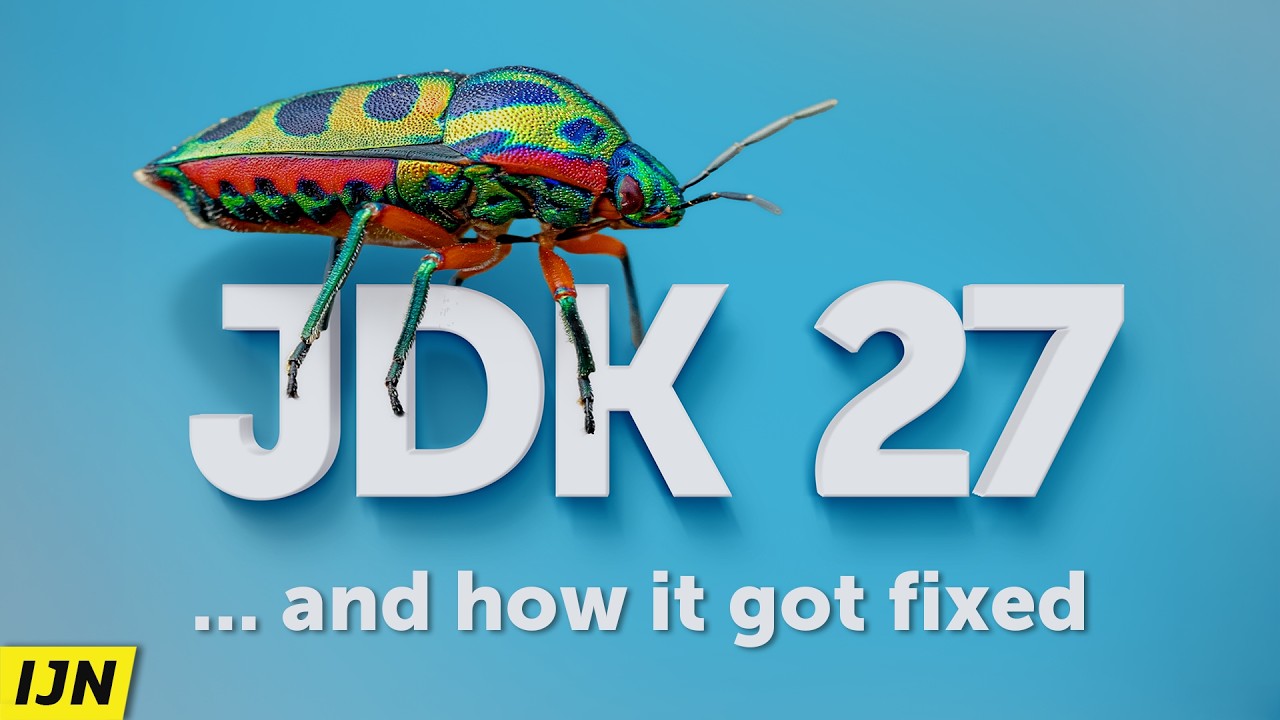
Join the Java 27 Launch!
Join us on September 15th for a special three-hour livestream as we celebrate the release of Java 27. Expect live coding, technical deep dives, and conversations with special guests from the JDK team and community.
Hundreds of tutorials, news and videos from the experts, all right here.
Stay Informed with the latest Java News and Events
Ron Pressler on September 4, 2026
Shawn Emery on September 3, 2026
Joe Darcy on August 27, 2026
Poonam Parhar on August 25, 2026
September 11, 2026 in Tapiei, Taiwan
September 15, 2026
October 5-9, 2026 in Antwerp, Belgium
October 12-15, 2026 in Colorado Springs, Colorado, United States
Been here before? Looking for something new to learn? Try these!
Invoke foreign functions that return pointers and check for potential errors.
A guide to download and setup a JavaFX runtime on your machine.
Packaging your application to create a native installer.
Learn about the future of the Java Platform
Join Brian Goetz (Java Language Architect) on a whirlwind tour of recent enhancements and future directions for the Java language with a special emphasis on Project Amber and Project Valhalla.
Java is a 30-year success story, made possible because its development consistently aligned with users' needs. In its early days, the platform required new features quickly, but over time, minimizing code breakage while carefully evolving the platform became essential. Critical junctures along that path included the introduction of modules and the current strive toward integrity by default.
Many Java features, existing and future, can meet the demands of AI. Existing features include the Foreign Function and Memory API and the Vector API. Future features include those proposed by Project Valhalla and Project Babylon. This video discusses these features and how they might be used by Java libraries and applications to build competitive AI solutions.
To assist performance, portability, and security, the Java Platform is progressing toward a state where its abstractions, as well as programmer-defined abstractions, can be made robust and invariants can be locally guaranteed. Libraries may violate some invariants but only if selectively allowed by the application. This session covers the why and how of the vision of "Integrity by Default".